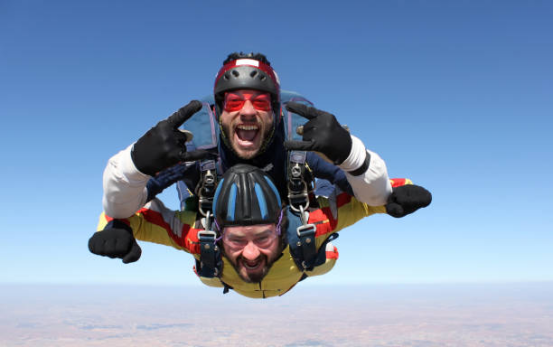
Skydiving, after all, is jumping from a place that is not meant for humans. The heartbeat rhythm changes with the altitude. Some people like to free fall from 10,000 feet, which is short and intense; some people prefer to fly from 18,000 feet, the higher the better, as if they can fly over the troubles in their heads. So, the question is: what exactly does the “altitude” of skydiving change?
Multiple choice question before skydiving: How high do you dare to fly?
Usually, skydiving centers will give you three options – like a menu, but not as easy as ordering.
10,000 feet : An entry-level model, not scary but not bland either.
14,000 feet : The intermediate version, giving you an extra half minute to scream.
18,000 feet : Well…it’s no longer called “skydiving”; it’s called “fighting the air”.
You may be thinking: if it is higher, then the free fall will last longer, just for a different time? That is not entirely true.
Jumping from 10,000 feet is a “just right” thrill
Many people choose this altitude for their first skydiving. You sit in the plane, and just as your legs touch the door, the chill is like a welcome ceremony from the atmosphere. After falling, there is about 30 seconds of free fall, which is not long, but it is enough to repeat the thought of “I will die” in your mind. When you open your eyes, the instructor is already holding you steadily from behind, the parachute is open, and the wind is light. You begin to understand why some people fall in love with this.
14,000 feet is enough time to think.
One minute may not sound special, but when you are free-falling in the air for one minute, the whole world slows down. Some people will scream until they lose their voice during this time, while others will suddenly become quiet, as if they are in a private sleepwalking. For experienced players, this kind of time can be used to “play moves” or practice postures. But for novices, this minute may just be a loop of “Aaaaaaa – isn’t it over yet?”
18,000 feet is not just high, it is also another level of difficulty
Let alone skydiving, even going to the toilet on the plane is uncomfortable at this altitude. In this thin air, you are not “jumping” down, but being dragged down by the air. Oxygen is necessary. Put on the mask in advance on the plane, take a deep breath, and then jump. A full two minutes of free fall is enough time for you to experience a “restart”. Some people say it’s like having a dream that you can’t wake up from.
Jump high, fly long, but there is a price to pay
The free fall from a high altitude sounds like a reward, but it also has challenges. First of all, there is the physical reaction. Some people are fine at 10,000 feet, but they start to feel their ears swollen and their heads empty at 18,000 feet. The other thing is the psychological endurance – the longer the fall, the easier it is to expose the fear in your heart.
Airplanes also have “limits”, they can’t fly as high as you want
Skydiving planes are not machines that can take you to unlimited altitude. For example, the common Cessna-182 can only take you to 10,000 feet at most. To fly higher, such as 14,000 or 18,000 feet, you have to switch to a larger model, such as the “Super Otter”. Interestingly, the choice of aircraft often limits the altitude you can experience.
How low can you jump? How high can you fly?
The lowest altitude for ordinary skydivers is generally 3,500 feet (yes, lower than some skyscrapers), while tandem skydivers usually jump from 8,000 feet because the parachute is more complicated and heavier. And the highest? About 18,000 feet is the limit. Going higher is not just “playing excitement”, but “challenging physiological limits.”
I remember the New England skydive very clearly.
It wasn’t because of the scenery, but because I really closed my eyes in the air at that moment. At about the 52nd second, when I was about to land, the wind suddenly changed slightly, and I felt like the wind around my ears stopped for a beat. That was the most real loneliness I felt in my life, and it was also the closest to “freedom”.
So, which height is best?
There is no answer to this question. In other words, only when you jump, you will know what is “right”.
If you are still hesitating and scared to death – then start at 10,000 feet and give yourself a proper step.
If you want to shake off the daily pressure in one go, 14,000 feet may be just enough for you to roar.
If you were not born to be a ground-level human, 18,000 feet, you are welcome.
Skydiving is not a competition or a show of skill. It is more like a private ceremony, an “air dialogue” between you and the world. How high you fly is, to some extent, how far you are willing to go.