If you ask someone who has just obtained a skydiving license what is the most addictive part of skydiving, the answer may vary from person to person. But if you ask “Which is more challenging and more intoxicating, free fall or parachuting”, you must carefully break down the differences in experience and skills between the two stages.
1. Free Fall: Embrace the Moment of the Unknown
That leap of determination changed everything
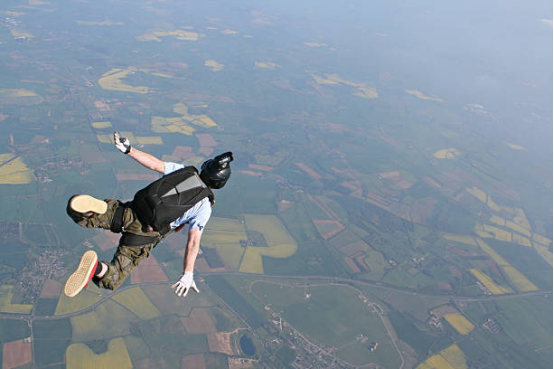
Free fall is the most thrilling beginning of a skydiving trip. When you stand alone at the door of the plane cabin, watching the wind whistling under your feet, and all the noise seems to be stagnant, you realize: this jump depends on you alone. This is not the entrustment and dependence in tandem skydiving, but a complete autonomy.
That leap is a step from fear to control. For the next 45 seconds, you fall at about 120 miles per hour, your body flying through the wind, but your soul is clearer than ever. Every second is pure existence. You are no longer yourself on the ground, but a light leaping into the unknown.
Skill training: full coordination of body and brain
Free fall is not only a carnival of the senses, but also a test of the limits of cognitive ability. You need to know how to stabilize your body, how to align your posture in the wind, and always pay attention to the altimeter. During training, the coach will teach you how to correct deviations by fine-tuning the posture of your hands and feet, and how to maintain a clear prediction of the next action.
This is a kind of “body-knowing” wisdom. When you are in the air, there is no room for error in every decision, and they must be deeply embedded in the neural circuits.
2. Parachute deployment: the transition from thrill to control
The moment the parachute opened, the world went silent
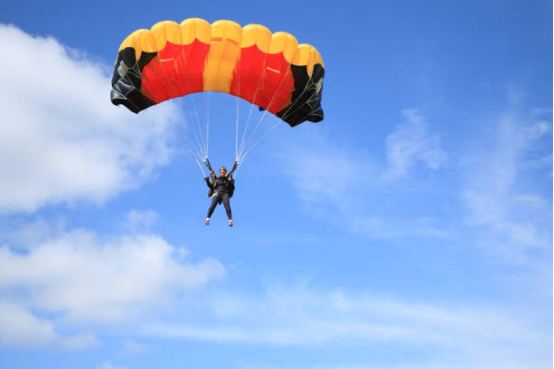
The moment you pull the parachute after the free fall ends is like a threshold to tranquility. The speed suddenly slows down, the sound of the wind fades away, and is replaced by a feeling of being gently held. You are floating in the air, and the world suddenly becomes vast and peaceful.
For skydivers, this transition is a dual adjustment of psychology and sensory. You ease down from the state of adrenaline burst and enter the stage of controlled air flight. You begin to feel the relationship between terrain, wind direction, and landing point, which is a completely different cognitive map from free fall.
Skills training: the battle between navigation and risk management
Parachuting may seem gentle, but it is actually highly dependent on skills. You must know how to adjust direction, speed and altitude through the left and right control ropes, how to identify wind changes and correct the route in time. The most important thing is: preparation before landing. When to slow down, how to pull up, when to lift your legs and slide down, these details determine whether you land smoothly or fall to the ground.
And every parachute jump is actually a dialogue with wind and gravity.
3. Differences in psychological experience: the transition from “survival” to “lifestyle”
Freefall awakens courage, parachuting builds confidence
For many skydivers, free fall is about the psychological breakthrough of “I can do it”. Parachuting is about the calm control of “I can control everything”. From the trepidation of the first jump to the calmness after successful parachuting, the mentality of skydivers has also undergone a qualitative change imperceptibly.
I remember the moment I successfully landed after my first parachute jump. I felt an unprecedented sense of pride. It was not because I “dared to jump”, but because I “could control it”. This experience also had a strong extension effect in my life. I began to believe that as long as I was willing to train myself, I could find a foothold in the unknown.
4. Community and Growth: Building a Sense of Belonging on the Fly
You are not alone, as long as you are willing to join the world of skydivers
Skydiving is not only a personal challenge, but also a cultural community. From the first day of ground school, you will be surrounded by skydivers who are calm, confident and supportive of each other. They joke with each other in the plane and talk freely in the skydiving area. They see life as an adventure in itself, not just an escape from boring work.
As you continue to practice free fall and parachute flying, you will also be infected by this aura. You begin to recognize familiar faces, learn to take a deep breath before taking off, and learn to find room for growth in fear. Skydiving is no longer a journey to get out of the ground again and again, but a journey to get closer to a stronger and more real self again and again.
5. Conclusion: Two Flights, One Turn in Life
Freefall is the limit, it is pure release; parachuting is control, it is a conscious choice. The combination of the two together constitutes a unique attitude towards life – you are no longer just living, but actively writing your own life trajectory every time you jump out of the hatch.
This year, I got my skydiving license, quit my old job, and entered the extreme sports industry. I became the one who “can fly” and the one who is no longer silent. What I want to tell you most is: no matter how scared you are when you stand in front of the hatch, once you jump out, the world will catch you in a whole new way. You just need to believe in the wind and yourself.