Skydiving sounds like a sudden dream of flying, maybe a little crazy, but that’s what makes it so addictive. Who would have thought that the sport we jump from planes and feel the thrill of free fall today actually had its seeds planted thousands of years ago?
The history of parachutes
Let’s start from the beginning. China – yes, in 86 BC, something similar to a parachute already appeared. Sima Qian recorded in “Records of the Grand Historian” a legend about an emperor “gliding” to escape from a burning building. You may laugh at this legend, but this “top-down” escape method does coincide with the idea of a parachute.
The first real design with pictures and facts was made by Leonardo da Vinci in the 15th century. He drew a pyramid-shaped parachute made of linen and wooden poles – although no one actually jumped with this parachute. But in the 21st century, a British pilot named Adrian Nicholas had an idea and jumped from a hot air balloon according to this drawing. Miraculously, he landed alive, which justified Leonardo da Vinci’s reputation.
Who was the first person to truly “skydive”?
Let’s go back a little further in history. In 1783, Frenchman Lenormand made a parachute that could “hold a person up” and jumped from a high tower. It sounds like a crazy experiment, but he really succeeded. A few years later, in 1797, another brave man, Garnerin, was even more daring: he jumped from a hydrogen balloon at 3,000 feet. This was the first real high-altitude skydiving by humans. It was not a show, his landing was really successful.
After the aircraft joined the battle
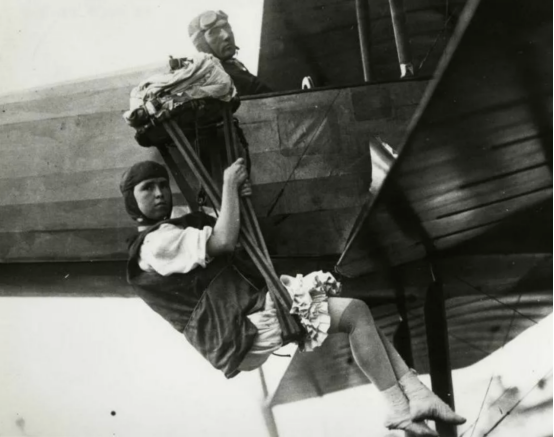
Then, airplanes appeared. In 1903, just a few years after the Wright brothers built the airplane, some people were thinking about jumping out of airplanes. In 1911, William Morton or Albury Berry (it’s unclear who it was) became one of the first people to jump out of an airplane. At that time, parachuting was not for entertainment, but for tactics – especially during World War I, when reconnaissance, raids, and emergency escapes were all needed.
Military parachuting developed rapidly, and the equipment became more and more reliable. After World War II, parachuting gradually evolved from a military tool to a civilian hobby.
Whose idea was it that skydiving became a “sport”?
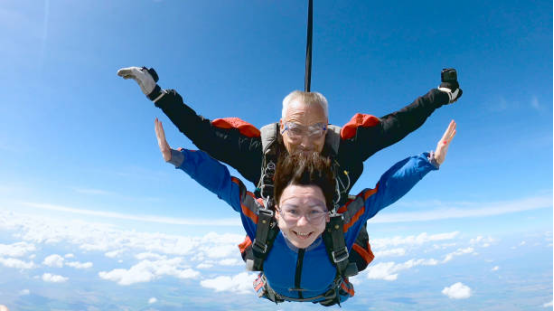
Skydiving really became popular in 1957. Jacques-André Istel, a Frenchman, was both the inventor and promoter. Two years later, he founded the world’s first civilian skydiving school, which gave ordinary people the opportunity to experience the thrill of high-altitude jumping. In 1983, Ted Strong invented “tandem skydiving” – novices could “fly” in the air just by tying themselves to their instructor. Since then, skydiving is no longer an elite privilege, but a heart-pounding choice for many people on vacation.
It’s not just the body that leaps
Millions of people now participate in skydiving every year. Not everyone considers themselves a superhero, but a few minutes of free fall is enough to make people redefine the word “freedom”. From the original towers and balloons to airplanes and jet parachutes, the current skydiving technology and safety are no longer what they used to be.
To trace the origin of the story, we have to mention Ganarin’s jump. He may not realize that the moment he jumped from a high altitude, he opened the door to another world of possibilities for mankind. Since then, skydiving is no longer just a means of survival, but has become a spiritual symbol: dare to jump, dare to live.
Summary: Skydiving is a posture
Skydiving is not just a sport, nor is it just a challenge to defy gravity. Sometimes, it is like a private ritual – looking fear in the face, and then jumping off. We always say “life needs a flight”, in fact, skydiving is one of the answers.
The moment you open your arms high in the sky, the human dream of flying is no longer an empty fantasy, but a real reality. Gravity cannot stop humans who desire to fly, and skydiving is the embodiment of that desire.