Why Land Training is Essential for Surfing Performance
Surfing is often perceived as an effortless dance with the ocean, but beneath that fluid motion lies a foundation of explosive power, cardiovascular endurance, and dynamic balance. While spending time in the water is crucial for reading waves and improving timing, land exercises provide a controlled environment to isolate and strengthen the specific muscle groups required for surfing.
The kinetic chain used in surfing demands a unique combination of upper body endurance for paddling, core rotational power for turning, and lower body stability for riding. By engaging in targeted land training, surfers can correct muscular imbalances, prevent common injuries such as rotator cuff tears and lower back pain, and significantly increase their wave count.
The Biomechanics of Surfing
Understanding the biomechanics of surfing helps explain why specific exercises are necessary. The act of surfing can be broken down into three distinct phases: paddling, the pop-up, and wave riding. Each phase taxes the body differently. Paddling requires sustained aerobic endurance and latissimus dorsi strength. The pop-up demands explosive fast-twitch muscle fiber activation in the chest, core, and hips. Finally, riding the wave requires exceptional proprioception and isometric leg strength.
The Top 5 Land Exercises for Surfers
To build a resilient and capable surfing body, you must replicate the physical demands of the ocean on dry land. Here are the five most effective exercises to integrate into your training regimen.
1. The Burpee to Surf Pop-Up
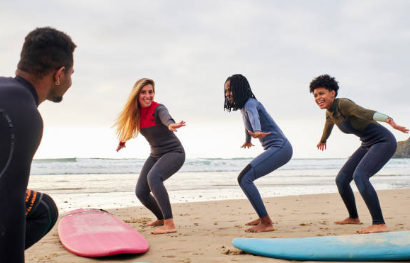
The pop-up is arguably the most critical maneuver in surfing. If you are slow to your feet, you will miss the wave or get caught in the whitewash. The burpee to surf pop-up mimics this exact movement.
Start in a standing position, drop into a push-up, and as you explode upward, twist your hips and land in your natural surfing stance (regular or goofy). The key is to land lightly with your knees bent, maintaining a low center of gravity. This exercise builds explosive chest power, hip mobility, and muscle memory.
2. Swiss Ball Dumbbell Rows
Paddling accounts for over 80 percent of a surfer’s time in the water. To build paddle endurance, you need a strong back and a stable core.
Lie face down with your chest supported by a Swiss ball, holding a dumbbell in each hand. Engage your core to maintain balance on the unstable surface, and row the dumbbells upward, squeezing your shoulder blades together. This exercise perfectly simulates the instability of a surfboard while targeting the lats, rhomboids, and rear deltoids.
3. Indo Board or Balance Board Squats
Riding a wave requires constant micro-adjustments in your lower body. Balance board squats train your nervous system to handle unstable environments.
Stand shoulder-width apart on a balance board. Slowly lower yourself into a deep squat while keeping your chest up and your eyes focused forward—just as you would when looking down the line of a wave. This builds isometric strength in the quadriceps and glutes while enhancing ankle stability.
4. Russian Twists with a Medicine Ball
Generating speed and executing sharp turns (like a snap or a cutback) requires immense rotational core strength. Your core acts as the transmission, transferring power from your upper body to your board.
Sit on the ground with your knees bent and feet elevated. Hold a medicine ball and explosively twist your torso from side to side, touching the ball to the ground near your hips. Keep your spine straight and focus on rotating from the obliques rather than just moving your arms.
5. Skater Jumps (Lateral Plyometrics)
Surfing is not a linear sport; it involves constant side-to-side weight shifting. Skater jumps develop lateral power and knee stability.
Leap horizontally from your right foot to your left foot, landing softly with a bent knee, and then immediately explode back to the right side. This lateral plyometric movement mimics the weight transfer needed to pump down the line and generate speed on the face of a wave.
Pro Tips for Maximizing Your Surf Workout
Performing the exercises is only half the battle. To truly reap the benefits, you must structure your workouts efficiently and prioritize recovery.
- Warm up dynamically: Never start explosive movements with cold muscles. Spend 10 minutes doing arm circles, hip openers, and light jogging.
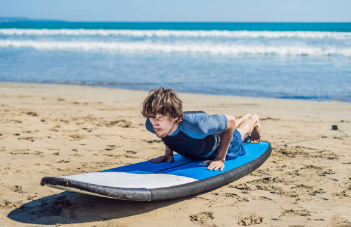
- Focus on form over speed: A sloppy pop-up on land translates to a sloppy pop-up in the water. Perfect your technique before adding speed.
- Incorporate breathwork: Surfing involves hold-downs. Practice nasal breathing during your workouts to improve your carbon dioxide tolerance.
- Stay consistent: Aim for 3 to 4 land sessions per week during flat spells to maintain your surf fitness.
Comparing Training Modalities
Understanding the difference between gym-based training and actual water time can help you balance your routine.
| Training Type | Primary Focus | Best For | Limitations |
|---|---|---|---|
| Land Exercises | Muscular isolation, strength, and explosive power. | Fixing imbalances and building a baseline of fitness. | Cannot replicate wave reading or ocean timing. |
| Water Training | Aerobic endurance and environmental adaptation. | Improving technique, timing, and wave knowledge. | Dependent on swell, weather, and daylight. |
Frequently Asked Questions (FAQ)
-
How often should I do these land exercises?
- For optimal results, integrate this routine 3 to 4 times a week, especially when the surf is flat. If you are surfing daily, reduce land training to 1 or 2 times a week to prevent overtraining.
-
Can land exercises completely replace actual surfing?
- No. While land exercises are incredible for building strength, flexibility, and muscle memory, surfing requires ocean knowledge, wave reading, and timing that can only be developed in the water.
-
Do I need a gym membership to train for surfing?
- Not at all. Most of the essential surf exercises, like pop-ups, skater jumps, and core work, require zero equipment and can be done in your living room or at a local park.
-
What is the best exercise for fixing a slow pop-up?
- The burpee to surf pop-up is the undisputed best exercise. It trains the exact motor pattern required. To improve, practice the movement slowly to ensure your feet land in the correct position, then gradually increase your explosive speed.