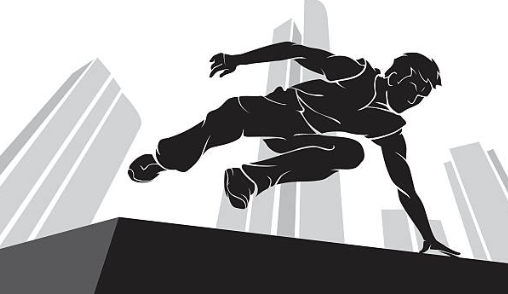
Parkour is often misunderstood as mere daredevil acrobatics—reckless jumping between rooftops and flipping off walls. While visually spectacular, this perception misses the soul of the discipline. At its core, Parkour is the art of efficient movement, a method of training the body and mind to overcome any obstacle in one’s path. It is a philosophy of utility, strength, and resilience, treating the urban landscape not as a set of limitations, but as a dynamic playground for self-expression and physical mastery. This guide will walk you through the foundational principles, essential conditioning, and core techniques you need to begin your journey, transforming how you see and interact with the world around you.
The Core Philosophy: Being Strong to Be Useful
Before learning a single vault or jump, it is crucial to understand the mindset that underpins Parkour. The discipline was founded in France by David Belle, inspired by his father’s training in “parcours du combattant,” a classical military obstacle course. The foundational motto of Parkour is “Être fort pour être utile” — “Be strong to be useful.” This principle emphasizes that physical prowess should serve a purpose, whether it’s helping someone in an emergency, escaping danger, or simply having the physical and mental fortitude to navigate life’s challenges. It’s a non-competitive discipline focused on self-improvement, where the only competition is with oneself. Practitioners, known as traceurs (male) or traceuses (female), strive for efficiency, control, and fluidity, not for style points or accolades.
Mental Discipline and Problem Solving
Parkour is as much a mental game as a physical one. Every wall, rail, or gap presents a unique problem. A traceur learns to analyze their environment, assess risk, and visualize a path through it. This cultivates a problem-solving mindset that extends beyond training. It teaches discipline, patience, and the ability to remain calm under pressure. The goal is to build confidence not through recklessness, but through a deep understanding of one’s own capabilities and limitations, and systematically working to expand them.
The Concept of Flow
As skills develop, Parkour becomes a form of “extreme dance,” a seamless and continuous motion through a complex environment. This state, often referred to as flow, is where thought and action merge. The traceur is no longer thinking about individual moves but is instead reacting intuitively to the environment, linking movements together in an uninterrupted chain. This is the ultimate expression of control and efficiency, where the city streets become a canvas for creative and purposeful movement.

Essential Physical Conditioning for Beginners
You cannot build a house on a weak foundation, and the same is true for Parkour. Attempting complex movements without the necessary physical preparation is a direct path to injury. Before you even think about jumping off anything, you must dedicate significant time to building functional strength, power, and resilience. This conditioning phase is non-negotiable and is the true starting point for any aspiring traceur.
Building Foundational Strength
Bodyweight exercises are the cornerstone of Parkour conditioning. They build the raw strength required to pull, push, and support your own body through various movements. Your initial goals should be focused on mastering the basics:
- Push-ups: Develops chest, shoulder, and tricep strength, essential for climbing and vaulting.
- Pull-ups: The single most important exercise for climbing power. If you can’t do one, start with dead hangs and negative pull-ups.
- Squats: Builds powerful legs for jumping and absorbs the impact of landings. Aim for deep, full-range-of-motion squats.
- Core Work: Planks and leg raises are critical for stability and control in every Parkour movement.
Developing Explosive Power
Once you have a solid strength base, you can begin training for explosiveness. This is the ability to generate maximum force in a short amount of time, which is key for jumping and dynamic movements. Incorporate exercises like:
- Broad Jumps: Focus on jumping for maximum distance from a standstill, ensuring a soft, controlled landing.
- Box Jumps: Jumping onto a stable, elevated surface. This trains vertical power and landing precision. Start with a low box and gradually increase the height.
Enhancing Balance and Coordination
Control is paramount in Parkour. You can build balance by simply walking and balancing on curbs or low-to-the-ground rails. This practice, known as “railing,” trains your focus and the stabilizer muscles in your ankles and core, which is vital for handling uneven or narrow surfaces.

Mastering the Fundamental Movements of Parkour
With a solid physical foundation, you can begin to practice the core techniques of Parkour. Always start at ground level in a safe environment, like a park with soft grass or a gym. The key is repetition and perfection of form before adding height or complexity. Each movement is a tool designed for overcoming a specific type of obstacle.
The Safety Roll (PK Roll)
This is the most important technique in all of Parkour. The safety roll is used to dissipate the force of a landing from a jump or drop, distributing the impact across your body instead of absorbing it all in your joints. You practice this by jumping from a low height and rolling diagonally across your back, from one shoulder to the opposite hip. Master this on grass until it becomes an automatic reflex.
Precision Jumps and Landings
A precision jump involves jumping from one specific point to another, often onto a narrow surface like a rail or a ledge. The focus is on accuracy and control. The landing is equally important; you should always land on the balls of your feet with your knees bent to absorb the impact, using your arms for balance. Practice this between two lines on the ground before ever attempting it at height.
Basic Vaults
A vault is any technique used to get over an obstacle, such as a wall or railing, without stopping. They are designed for efficiency and maintaining momentum. Start with low, stable obstacles.
- Safety Vault: A simple, controlled vault where you place one hand and your opposite foot on the obstacle and swing your other leg through.
- Speed Vault: A more dynamic vault where you place one hand on the obstacle and propel your entire body over it sideways.
- Lazy Vault: A fluid vault where you approach an obstacle from the side, place your inside hand down, and swing your legs over.
Climbing and Mantling (The Wall Pass)
Getting up and over high walls is a fundamental skill. This often starts with a Cat Leap, where you jump towards a wall, grabbing the top with your hands while planting your feet against its surface. From there, you perform a mantle or “climb-up” to get on top of the obstacle, which is essentially a powerful, unsupported dip that pushes your body up and over the ledge.

Your First Steps: How to Start Training Safely
Enthusiasm is great, but safety and smart progression are what ensure longevity in Parkour. A disciplined approach to training will prevent injuries and lead to much faster and more sustainable skill development. The “go big or go home” mentality has no place here; instead, embrace a mindset of patience and incremental progress.
Finding the Right Training Spot
Your first training ground should be safe and forgiving. A local park with grassy areas, low benches, and sturdy railings is ideal. Avoid training on concrete initially. A dedicated Parkour gym, if available, is an excellent resource for learning foundational skills in a controlled environment with soft mats and experienced instructors. The goal is to find a place where you can fail safely.
The “Progression” Mindset
Progression is the cornerstone of safe training. Never attempt a movement in a risky environment (e.g., at height) that you have not mastered at ground level. If you want to jump a gap between two walls, first practice jumping the same distance on a line painted on the ground hundreds of times. This builds not only the physical skill but also the mental confidence that comes from true competence, not just bravery.
Essential Gear (or Lack Thereof)
Parkour requires very little gear, which is part of its appeal. You don’t need expensive equipment, just comfortable, non-restrictive clothing and a good pair of running shoes. The ideal shoe has good grip, a flexible sole for feeling the surface you’re on, and a single-piece sole for durability. Avoid overly cushioned or bulky shoes, as they can hinder your balance and increase the risk of ankle rolls.

Parkour as Urban Expression: The City as a Canvas
Once you have a firm grasp of the fundamentals, your perception of the world begins to change. A staircase is no longer just for walking; it’s a series of platforms for precision jumps. A wall is not an end point but a potential path upwards. This shift in perspective is where Parkour transcends physical exercise and becomes a form of art and self-expression. It is about creatively interacting with the urban environment and finding new, efficient, and fluid paths where others see only barriers.
Redefining Obstacles as Opportunities
The core of this expressive “dance” is the ability to see opportunities instead of obstacles. This requires a creative eye and a deep understanding of your own movement capabilities. A traceur looks at a set of railings, benches, and walls and visualizes a line—a sequence of movements that connect them seamlessly. This creative problem-solving is a deeply personal and rewarding aspect of the discipline. No two traceurs will move through the same space in exactly the same way, as each brings their own unique style and physical attributes to the challenge.
The Pursuit of a Lifelong Discipline
Parkour is not a sport with a finish line. It is a lifelong practice of self-improvement. The journey involves constant training, pushing your limits safely, and continually refining your movement. It builds a resilient body and a disciplined mind, teaching you to face challenges—both physical and metaphorical—with confidence, creativity, and control. By embracing its philosophy and dedicating yourself to the fundamentals, you can unlock a profound new way to interact with the world and discover the incredible potential of your own body.
Frequently Asked Questions (FAQ)
- What is the difference between Parkour and Freerunning?
- While often used interchangeably, there is a subtle philosophical difference. Traditional Parkour focuses strictly on efficiency and A-to-B movement—getting over obstacles as quickly and effectively as possible. Freerunning, a term coined by Parkour co-founder Sébastien Foucan, incorporates more aesthetic and acrobatic movements like flips and spins. Freerunning prioritizes freedom of expression, while Parkour prioritizes utility.
- Is Parkour dangerous for beginners?
- Any physical activity carries risk, but Parkour is only as dangerous as you make it. When practiced correctly with a focus on slow, safe progressions and extensive conditioning, it is relatively safe. Most injuries occur when beginners try to perform advanced moves they see online without putting in the foundational work. Patience and discipline are your best safety tools.
- Do I need to be in great shape to start Parkour?
- No, you do not need to be an elite athlete to start. In fact, Parkour is an excellent way to get in shape. The key is to start with the very basics: bodyweight conditioning. Focus on building a foundation of strength with push-ups, squats, and pull-ups before you even attempt the specific movements. The discipline itself will build the physique you need.
- How long does it take to get good at Parkour?
- There is no set timeline. Progress depends on your starting fitness level, dedication, quality of training, and consistency. It can take several months to a year of consistent practice to become proficient in the basic movements. However, Parkour is considered a lifelong journey of improvement, not a destination to be reached.
- Is Parkour legal?
- The legality of Parkour depends on where you practice it. Training in public parks and open spaces is generally acceptable. However, practicing on private property, government buildings, or culturally sensitive sites can be considered trespassing. It is crucial to be respectful of property, avoid causing damage, and be a positive ambassador for the discipline by training responsibly and interacting politely with the public and authorities.