You’ve grown accustomed to the weightlessness of high altitudes, and you calmly handle strong air currents and sudden changes. You’ve mastered how to make precise trajectory adjustments in the air, how to prevent parachute lines from getting tangled, and how to outsmart the wind, soaring through the sky like a bird. But there’s one thing you absolutely cannot overlook: ground skills .
You may not have noticed, but the most dangerous moment during skydiving is often not when you are flying in the clouds, but when you are less than a few meters from the ground— the moment of descent .
Whether you’re skydiving or extreme BASE jumping, every time you touch the ground carries a significant risk. That 0.1-second contact can determine the safety of your ankles, spine, and even your entire body.
At this point, you might be thinking: “Isn’t there a better way to prevent injury during a parachute jump?”
The answer is yes.
If you’ve ever seen a group of parkour enthusiasts rapidly tumbling and leaping over obstacles on the street, you might wonder why they’re so adept at handling the impact of landing. In fact, top skydivers, especially BASE jumpers, are increasingly drawing inspiration from these urban extreme sports enthusiasts , re-evaluating their own ground contact techniques.
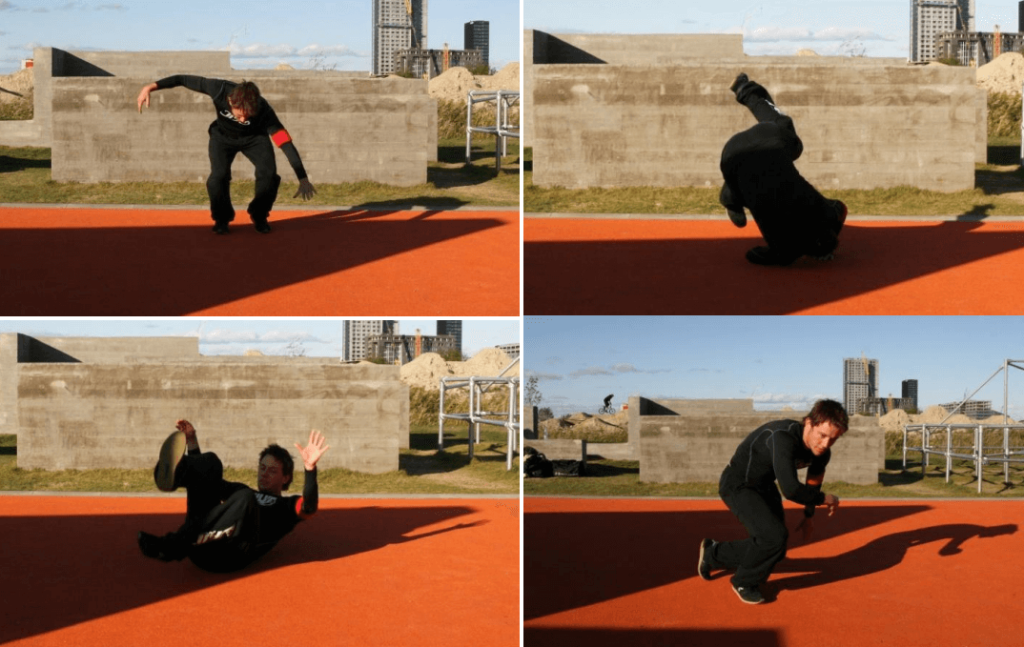
In particular, the “Parkour Roll” technique in parkour is not just a simple “roll,” but a perfect control and conversion of impact force, providing active protection for your “hard landing.” Compared with the traditional PLF (Parachute Landing Fall), this technique can be described as an “efficient and flexible” innovation.
PLF: A defensive strategy that sacrifices the tank.
The five-point landing method (PLF) was first developed by paratroopers during World War II to cope with the impact of landing from a high altitude after parachuting. Its principle is to disperse the impact force by striking the ground in sequence with the feet, calves, thighs, buttocks, and back.
PLF (Parakistoscope) can indeed effectively reduce the risk of fractures, but it is a typical passive defense mechanism. That is to say, in most cases, it simply helps you better withstand impact and reduces the probability of injury. However, one problem is that its movements are relatively “rigid” and often not flexible enough when dealing with unexpected situations in complex terrain and different environments.
For skydivers, the most fatal moment is often the instant of impact with the ground. At that moment, even a slight misstep can lead to serious injury. This is especially true for low-altitude (BASE) jumps, where the landing area is often not a wide open space, but rather a narrow area of buildings, rocks, or even a concrete jungle. In such situations, the protective function of a PLF (Plane Force Flyover) may be insufficient.
Parkour Roll: Active Protection for Energy Conversion
Compared to the passive “impact” of PLF, the Parkour Roll in parkour is an active energy conversion.
Fluid Logic :
When parkour athletes jump from a height, they don’t slam down on the ground like sandbags. Instead, they use body rotation to convert the kinetic energy of the vertical fall into horizontal rolling energy. This rolling motion not only effectively mitigates the impact but also quickly helps the athlete regain a standing posture.
Joint protection :
Compared to traditional PLF techniques, parkour rolls are more effective at dissipating impact from the knees and spine. This is because during a roll, the impact force is distributed through the flexibility of the entire body, rather than being confined to a hard landing in one area. For expert low-altitude skydivers, this skill is undoubtedly the last line of defense on the “line of life and death.”
More than just skills, it’s a survival instinct :
Parkour training enables you to react more quickly and accurately when landing on complex terrain. You no longer rely on inertia to passively disperse the impact, but actively transform the impact force to adapt to different environments. Just like a skydiver landing in a concrete jungle, accurate rolls can help you avoid sharp rocks and prevent injury.
Spatial Awareness: Obstacle Avoidance from 2D to 3D
In the air, obstacles are usually far away, and you only need to focus on wind speed, airflow, and trajectory. However, in low-altitude skydiving, especially BASE jumps, ground obstacles are right in front of you and may approach you at extremely high speeds. At this moment, you must make a split-second judgment to avoid unsafe areas.
The core of urban extreme sports (such as skateboarding and parkour) is “immediate obstacle solving.” Parkour training significantly improves your spatial awareness and proprioception. When you balance on a hurdle or leap over a hurdle, your brain is already training how to “see” obstacles in the next few seconds and make optimal decisions accordingly.
Parkour is more than just jumping between obstacles; it’s a sport that trains reaction speed and spatial awareness . Once you master the skill of quickly navigating between railings, stairs, and walls, your brain automatically calculates the optimal route within milliseconds.
This not only helps you improve your reaction speed when doing parkour on the street, but also allows you to avoid obstacles in front of you by making instantaneous judgments when skydiving.
In conclusion: The sky is the playground, but the ground is the final destination.
Skydiving is about flying, but the ground is our final destination.
As a skydiver, the sky opens up a whole new world for you, but the ground is a place you must respect. You can’t stay in the clouds forever; eventually, you’ll return to the ground. And as you rapidly approach the ground from high altitude, never forget: the real challenge isn’t in the sky, but on the ground .
If you want to better protect yourself and improve your overall skydiving skills, in addition to focusing on high-altitude aerodynamic training, you might as well spend some time on the ground and try out parkour training in the city.
In parkour training, your body will be honed into a perfect shock absorber. Learning how to land gracefully and quickly is to give you the skills to challenge higher and more treacherous skies. Remember, the best pilots are also the best at “crashing.”