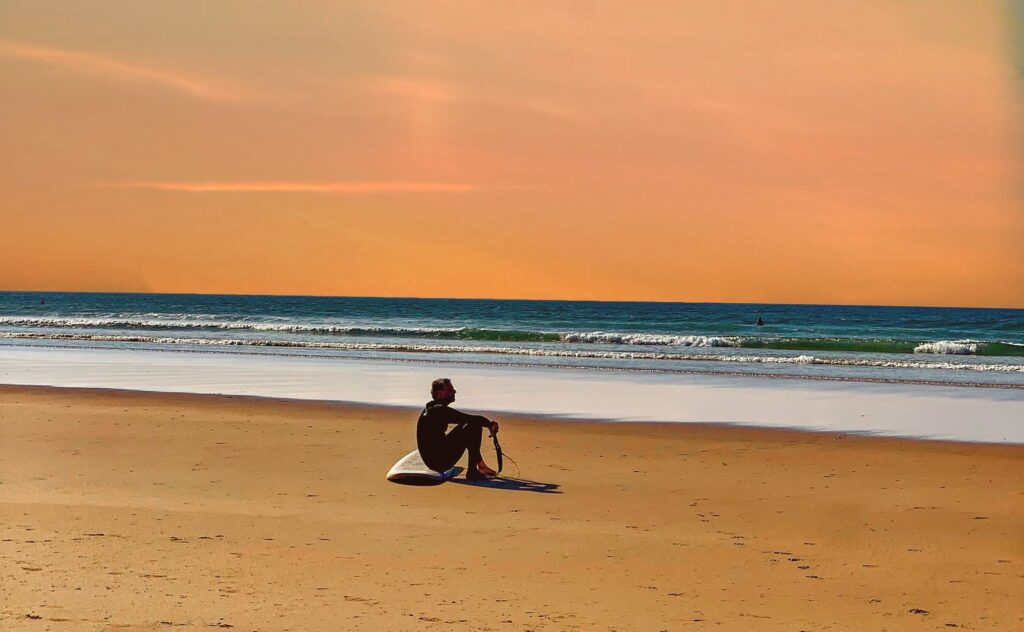
If you’re a surfer, you’ve probably experienced this cruel reality:
you travel thousands of miles to the beach, apply surf wax, tie your leashes, and are halfway through putting on your wetsuit, only to push open the shoreline and find the water as still as a sheet of glass. Not a single wave. Not only are there no waves, but they’re also reluctant to even “cough” in the distance.
For kitesurfers, wing surfers, and extreme water sports enthusiasts, the most frustrating moment is never falling down covered in sand, but rather when the ocean stops moving—
those helpless “Flat Days.”
As you stroll along the beach, watching the wave forecast update hour by hour, a strange sense of anxiety begins to creep in:
“If I don’t stop moving soon, I’ll rust all over.”
But true extreme sports enthusiasts don’t let natural conditions dictate their happiness.
They turn inward, looking towards the mountains.
Because in the extreme sports community, there is an almost unspoken consensus:
mountain biking (MTB) is “surfing on dirt”.
It sounds like an advertisement, but once you’ve been on a real Flow Trail, your body will immediately understand:
“Oh, so this is the same thing as the thrill of surfing.”
Furthermore, many professional surfers, freelance surfers, and surf instructors ride mountain bikes during the off-season. It’s not because they have nothing better to do, but because they know that these two sports are essentially from the same source in terms of biomechanics, line judgment, body balance, rhythm, and “flow.”
If you’re willing to delve deeper into extreme sports in the mountains and forests , you’ll discover that it’s not just a substitute, but a genuinely effective way to improve your water skills—an underrated “land surfing system.”
From ocean waves to mountain trails: Searching for the lost and regained “Flow”
The allure of surfing lies not only in speed and power, but also in an almost metaphysical experience:
you are not “riding the wave,” you are being lifted up by the wave, and then creating a synchronized rhythm with your movements, board, center of gravity, and the water surface.
This experience is called “Flow”.
You’re not constantly in a state of explosive energy, nor are you constantly tense. Instead, you react with your body in brief but intense moments, following the changing wave-like patterns.
It’s a sense of fluidity, as if you’re being “pulled along by the environment.”
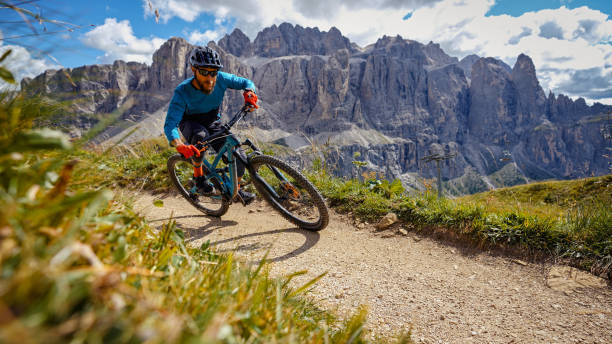
Modern mountain bike parks have almost perfectly replicated this – especially Flow Trail.
The designers of these trails didn’t just randomly dig a few roads into the mountains; instead, they sculpted the mountains like carving ocean waves, creating stable, continuous, and rhythmic terrain that allows riders to “accelerate by relying on the terrain” without pedaling.
If you’ve never experienced this feeling, you might think mountain biking is tiring, wild, and dangerous.
But when you’re smoothly pumping, drifting, and hugging the curves along a mountain road, only one sentence will come to mind:
“So this is what waves made of mud look like.”
1. Pumping: A shared language of surfing and mountain biking
In surfing, the pumping motion of the knees is key to acceleration.
You don’t move forward by “treading water,” but by compressing the wave wall and then releasing it with the force of the wave.
When you’re on a mountain bike facing a series of mounds and bends, you’re doing exactly the same thing:
As you approach the mound, press your body down (compress).
Relax at the top of the slope, allowing the suspension to bounce (release).
Accelerate as you enter the downhill section.
Repeat the rhythm
Moreover, mountain biking has an “overpowered mode” compared to surfing:
it’s controllable.
Waves may suddenly disappear or break apart, but the terrain of a mountain trail is designed so that the rhythm is almost predictable.
Many surfers instinctively laugh out loud when they first experience the pumping sensation of an MTB (Medium-to-Boom) surfer.
That feeling of surprise, “Huh? It feels exactly like accelerating on the wave wall?”, is a common experience for almost everyone.
This full-body rhythm not only helps you get rid of the anxiety brought on a waveless day, but also keeps you alert to dynamic balance, keeping your knees, core, and thighs in a “surfing state.”
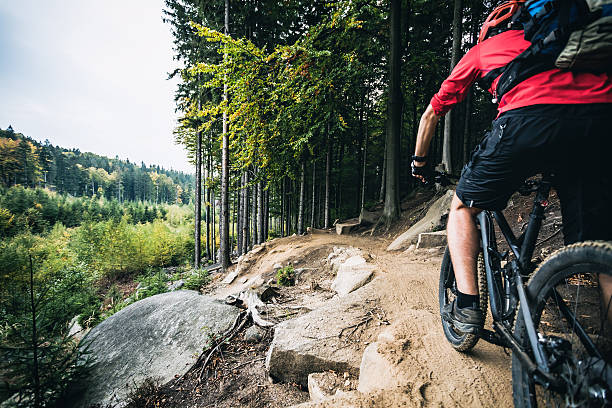
2. Line Choice: Common Survival Rules for Ocean Waves and Mountain Roads
When surfing, you’re never just standing there.
You’re observing the slope of the wave, the break point, and the most energetic pockets. You have to decide which way to go 1-2 seconds in advance.
Mountain bikes are faster, but the logic is exactly the same—or even stronger.
When you’re rolling down a hill at 30-40 km/h, the information density of the road surface is far greater than that of a wave.
Rocks, tree roots, V-shaped ditches, soil particles, turning angles… any detail can cause your vehicle to veer off course.
So you start practicing a skill similar to “foresight”:
you have to look 5-10 meters away, not in front of you.
One of the biggest mistakes some surfers make when riding a mountain bike for the first time is “staring at the front wheel.”
Once you look up and look into the distance, you’ll suddenly realize:
The car will follow your line of sight.
This is the core principle of surfing.
Where you look, the board goes.
Intuitive judgment becomes more important than muscle strength.
This ability to read in a suitable environment is a common passport for both water and land extreme sports.
You can’t wait for the waves, but you can create them in the mountains.
The rhythm of the ocean is beyond your control.
But the mountains—are always there.
Whether the wind stops, the waves subside, or the tide recedes, they do not “hibernate” because of the weather.
If you experience MTB in depth, you’ll find that many of its facilities are completely modeled after the motions and structures of surfing.
Berms: Unbreakable “perpetual tube waves”
What you’re chasing in a barrel is speed and the thrill of gliding close to the wave surface.
Berm is essentially the same:
you’re gliding at high speed along a curved wall, and the centrifugal force will make your thighs burn.
And it will never break or fracture, so you can surf indefinitely.
It’s paradise for surfers.
Drops: Simulates the “free fall” of a wave crest taking off.
When you take off at the crest of a wave, the momentary feeling of weightlessness can make your stomach suddenly swell.
Mountain bike drops are the “land version” of this feeling.
The movements of jumping off the edge, maintaining balance in the air, and absorbing shock upon landing are almost identical to the body posture of surfers riding down a wave.
Many surfers experience a long-lost “Oh! This is it!” feeling when they practice Drop for the first time.
After the perspective changes, you will see a completely new world.
When you get used to surfing, your body will default to “happiness comes from being near the sea,”
but actually your happiness comes from—
The ability to adapt to the environment.
When you ride a mountain bike through the woods, you will find:
The wind is still whistling in your ears
The rhythmic shifts in the center of gravity still keep you immersed.
Each bend in the wall is like a wave.
Each earthen slope is like the crest of a wave.
Each continuous flow can bring you into a familiar “flow” state.
You might suddenly realize:
“What I miss isn’t the waves, but the flow.”
And this sense of movement can be found in the mountains—and it can be found anytime.
In conclusion: When the sea is as calm as a mirror, leave the waves to the sea, and take back your own speed.
Extreme athletes are all a bit stubborn: we don’t like to wait passively.
If the ocean doesn’t move, we move.
Don’t tie your happiness to the waves.
The moment you put your surfboard back on the rack, put on your helmet, and get on your mountain bike, you’ll instantly understand:
Nature offers more than one way to enter a state of flow.
Water flows, and so does the earth.
Waves lift you up, and so do mountains.
Next time a weather forecast says “Flat” or “0-0.5ft,”
don’t just sigh and hold your phone.
Pack your water bottle, put on your protective gear, and head to the mountains to find your “muddy waves.”
You’ll find that
when you return to the shore, you’re not only not rusty, but you’re also faster, more accurate, and more daring.
Because on waveless days, you don’t wait in one place.
You continue surfing in the mountains.