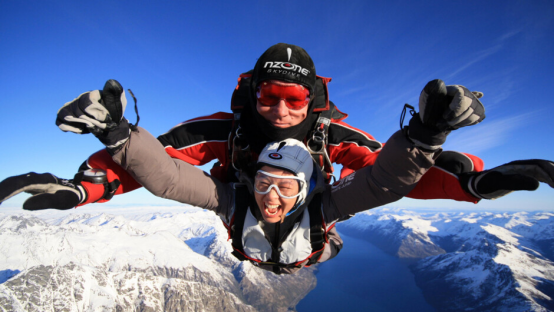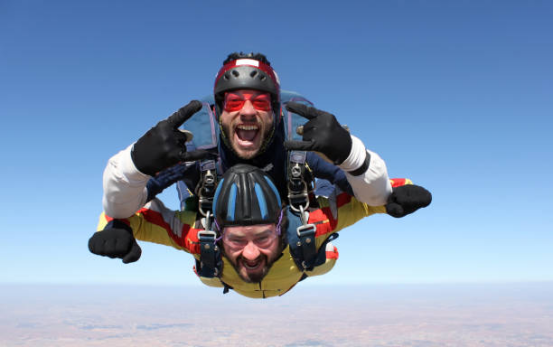
Planning your first skydive? Besides “Will I be scared?”, another question often lingers in beginners’ minds: “Will I shiver from the cold?”
The answer is simple: it will be cold, but you can definitely prepare for it . In this practical guide, we’ll break it down.
- How does temperature change during skydiving?
- What are the differences between winter and summer experiences?
- How to dress warmly without sacrificing safety and comfort
1. The Higher, the Colder: The Relationship between Skydiving Altitude and Temperature
We all know that planes get higher as they fly, but you might not know that the temperature drops by about 2°C (3.5°F) for every 1,000 feet (about 305 meters) of altitude . Skydiving is typically done between 10,000 and 14,000 feet (3,000–4,200 meters):
| high | Estimated air temperature (relative to ground level) |
| Ground: 21°C (70°F) | — |
| 10,000 feet | About 2°C (35°F) |
| 14,000 feet | About -6°C (21°F) |
But that’s just the static temperature – don’t forget the wind chill !
During free fall, your body will be traveling through the air at 120 mph (about 200 km/h), which can cause the perceived temperature to drop by another 11–16°C (20–30°F) .
This means that at 14,000 feet, the actual temperature might feel closer to -23°C (-10°F) !
The good news? Free fall only lasts about 60 seconds, and the coldest part is about a minute.
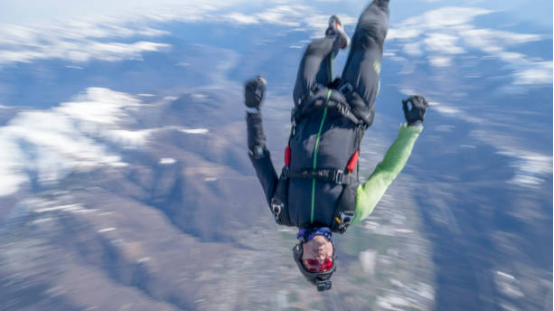
2. How big is the difference between skydiving in winter and summer?
❄️ Winter skydiving
If the ground temperature is close to 0°C, the temperature at high altitude may drop to below -29°C (-20°F).
When it is too cold, the Drop Zone may be closed.
Layering is key (see below for suggestions)
☀️ Summer skydiving
Even if it is 27°C (80°F) at ground level, it may still be only 4°C (40°F) at 10,000 feet.
It is colder when skydiving in the early morning, when there is less sunlight and the air humidity is high, and the body feels even colder
Reddit skydiver’s real story: ” I skydived in July, and even with a jumpsuit, my face felt like it was scraped by ice during the free fall! “
3. Is Free Fall Cold? Analysis of the Experience Phase
Many people think that whether you feel cold while skydiving depends on your clothing, but it actually depends more on the stages of your body’s reaction :
First 2 seconds: “I didn’t even notice how cold it was!” (Adrenaline rush)
Next 10 seconds: “My face feels frozen…”
After the parachute opened: “Much better, just a little bit of a cool breeze.”
The areas most susceptible to freezing are the face and hands – exposed + high-speed wind, the feeling of cold is most obvious.
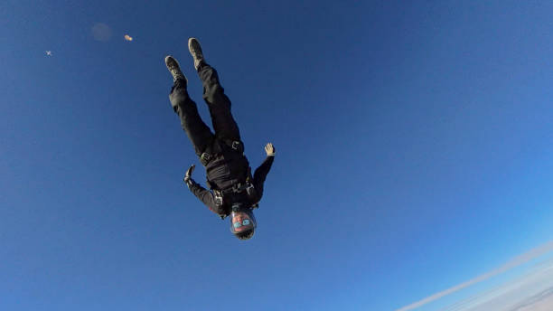
4. How to dress warmly and safely?
Skydiving equipment requires flexibility, safety, and wind resistance . The following is a recommended outfit guide:
Recommended clothing:
Skydiving jumpsuit : Most DZ (skydiving base) will provide, windproof design
Base layer (next to skin) : long sleeves and pants (synthetic, not cotton) that wick away moisture
Mid-layer (warmth) : Light fleece or thermal jacket (make sure it does not interfere with the harness)
Gloves : Thin and windproof skydiving-specific gloves (some DZ offers)
Helmet + goggles : protect against wind and cold and also protect your face
Thick socks : wool is best
Not recommended:
Loose-fitting hoodies (which flap in the wind and may interfere with movement)
Bulky jacket (which affects the fit of the harness)
Decorative jewelry (may be lost or frozen to the skin)
5. Is there a time when it is “too cold to jump”?
will suspend jumps if :
Ground temperature below -1°C (30°F)
Frost or ice on the aircraft or equipment
Cold Jump Tips:
Check the wind chill forecast and avoid extreme wind combinations
Drink water before jumping , as cold air can accelerate dehydration
Exercise before boarding to improve circulation and retain heat
A professional coach said it well: “If you are shivering with cold on the ground, you will be even worse in the air.”
6. What do real skydivers say?
We scoured some skydiving forums (including Reddit and Dropzone.com) and found that real skydivers had pretty consistent opinions on what it’s like to be cold:
“After jumping more than 100 times, I no longer notice the cold. My attention is completely absorbed by the feeling of flying .”
“The coldest I ever danced was in the summer. The humidity and wind made my face numb!”
“Skydiving in winter is challenging, but the snowy scenery from the air is so worth it .”
Conclusion: Being cold is not a problem, as long as you are prepared
To summarize, if you are planning to skydive:
Expect to be very cold during free fall, especially on your face and hands.
Smart clothing is more important than heavy clothing (layers but be flexible).
Once you jump, the cold will be “diluted” by the adrenaline.
If you’re thinking about skydiving but are hesitant because you’re afraid of the cold – don’t worry, most first-time skydivers forget everything else as soon as the door opens, leaving only pure surprise and excitement.
Have you ever skydived? Do you feel cold? Share your skydiving stories in the comments.